Accreditations
of EIFJ Tokyo
The Tokyo Metropolitan Government (TMG)
The school has been officially registered with local and national authorities since July 30, 2018, and has held declared childcare facility status (ninkagai) since February 22, 2019, in full accordance with the provisions of Article 59-2, Paragraph 1 of the Child Welfare Act (Jidō Fukushi Hō).
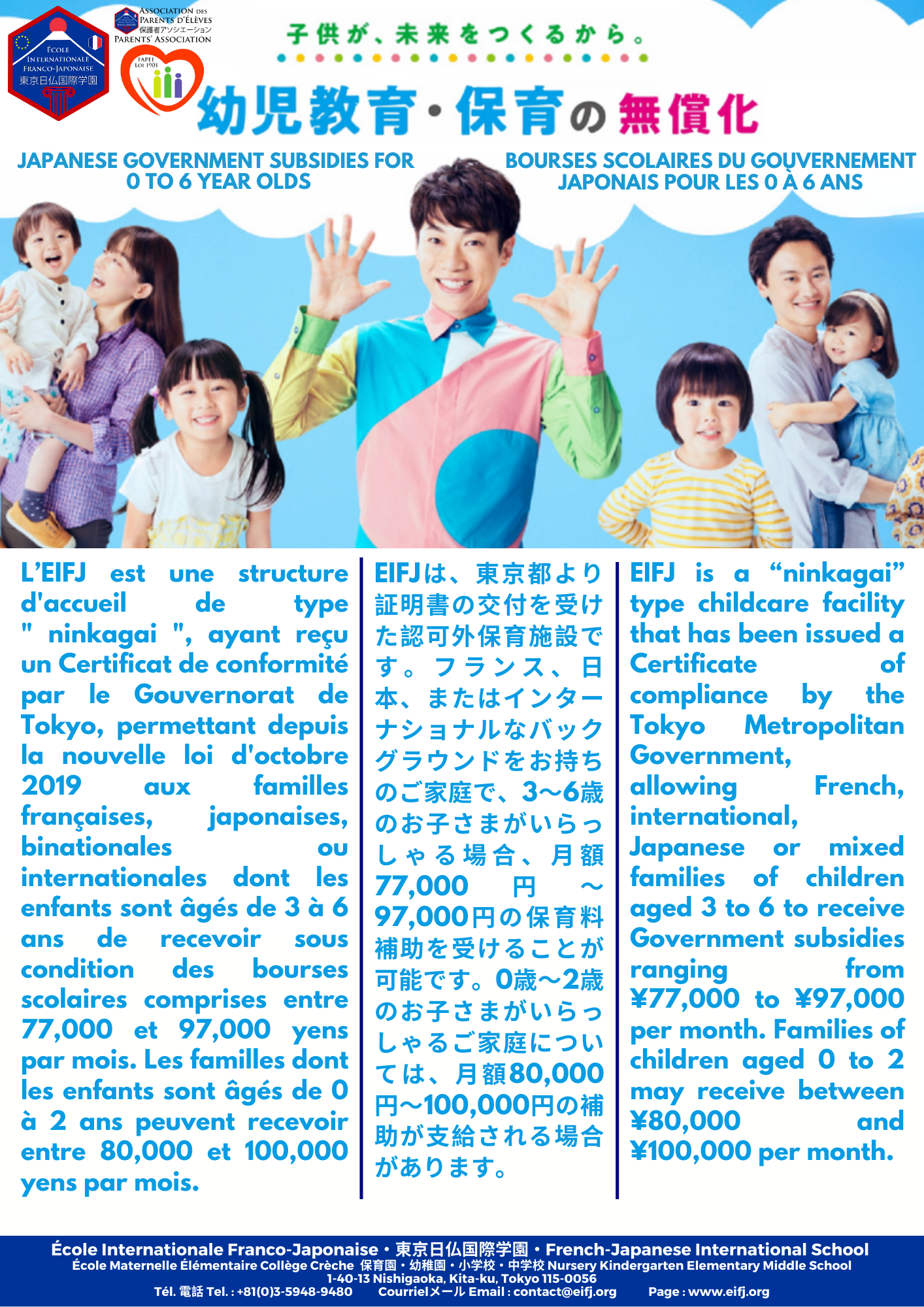
In January 2024, the Nishigaoka campus was awarded its Certificate of Compliance by the Tokyo Metropolitan Government (TMG). Under the national early childhood education and care support framework established in October 2019, this official recognition allows eligible families (French, Japanese, dual-national, or international) with children aged 0 to 6 (from nursery through Grade 1) to receive monthly educational subsidies ranging from 37,000 to 100,000 yen.
This Certificate of Compliance was successfully renewed in January 2026, ensuring the continuity of this accreditation and allowing families to continue benefiting from enhanced support subsidies.
Annual unexpected audits and observation visits are organized by the Tokyo Metropolitan Government and Kita-ku office, continuous assessment of fifty criteria. Implications: fire / earthquake monthly drills, annual or monthly medical tests of active employees, registration with the fire station, adequate available space for each child, sufficient toilets, Safety plan, adequate safety equipment, sufficient number of qualified employees, building architecture, adequate hygiene, registration of daily health checkups for children, immunization checks, daily family reports, etc.
The French Ministry of Education
Aspiring to obtain accreditation from the French Ministry of National Education, our institution has been issued a Certificate of Compliance from the Tokyo Metropolitan Government, enabling access to Government subsidies, and is also part of the global network of French international schools managed by the Mission Laïque Française, which includes 108 institutions in 32 countries, a network operating within the legal framework of agreements with AEFE, the French Ministry of Education, and the Ministry for Europe and Foreign Affairs.
Schools outside France follow a procedure that attests to their compliance with the programs, pedagogical aims and fundamental principles of French education:
- Principles, programs and implementation of the French school system;
- Mastering of the French language;
- Multilingual language policy;
- Qualified and regularly trained staff;
- Assessment, preparation and sitting of French examinations;
- Existence and safety of premises and equipment;
- Ongoing compliance with accreditation criteria.
International Baccalaureate Organization
Why be an IB School?
Today’s world faces complex challenges: conflict, inequality, pandemics, exclusion, and fast-paced technological change. Education must evolve to meet these demands. The International Baccalaureate (IB) responds with a globally respected model that promotes collaboration, responsibility, and intercultural understanding.
The IB develops inquiring, knowledgeable, and caring young people who strive for a more peaceful world. Its programs are academically rigorous and support personal, intellectual, emotional, and ethical growth. IB students consistently excel in critical thinking, research, and university readiness.
With over 6,000 schools in 160 countries, the IB is a global leader in education. It’s recognized by 4,500+ universities worldwide, offering students strong placement opportunities and higher acceptance rates. Teachers also benefit from world-class training and collaboration.
In Japan, the IB is supported by the government and meets the growing demand for global education. French international schools are increasingly embracing the IB, strengthening their appeal and opening global pathways. At EIFJ Tokyo, our French-English-Japanese model reflects this vision—bringing IB excellence to the next generation in Tokyo.
École Internationale Franco-Japonaise 東京日仏国際学園 is now officially authorized as an IB World School for the Primary Years Programme (PYP) , following several years of preparation and a successful evaluation visit in January 2026. As the first French international school accredited for the IB PYP in Asia, EIFJ has received major recognition from the International Baccalaureate Organization. The school now joins a global community committed to academic excellence, international-mindedness, and the development of knowledgeable, caring, and responsible students. This significant milestone reflects the dedication of our leadership team, teachers, staff, students, and families, and further strengthens our mission to provide an ambitious, internationally recognized English-French-Japanese education in Tokyo.
Building upon this achievement and ensuring seamless pedagogical continuity, École Internationale Franco-Japonaise 東京日仏国際学園 is proud to announce that it has officially attained IB Middle Years Programme (MYP) Candidate School status in September 2026. This milestone marks a decisive step in extending our inquiry-based, multilingual education into secondary school, fostering intellectual rigor, critical thinking, and intercultural understanding as our students transition through their adolescent years.
Looking ahead, this achievement also lays the groundwork for our next strategic commitment: pursuing candidate status and future authorization for the High School. By steadily building toward a continuity of its programs, EIFJ reinforces its standing as a forward-looking international school dedicated to nurturing compassionate, globally minded leaders in Tokyo.
The IB Framework: An International Continuum of Learning
EIFJ Tokyo is an authorized IB World School offering the Primary Years Programme (PYP) and a candidate school for the IB Middle Years Programme (MYP / Middle School). The school delivers the French Ministry of National Education curriculum, implements the US Common Core State Standards for English Language Arts (ELA), and adheres to the Japanese Ministry of Education (MEXT) standards for Japanese language instruction, within a coherent educational pathway aligned with the IB philosophy.
The International Baccalaureate (IB) offers a continuum of programmes designed to support students from early childhood through adolescence, fostering inquiry, critical thinking, and international-mindedness.
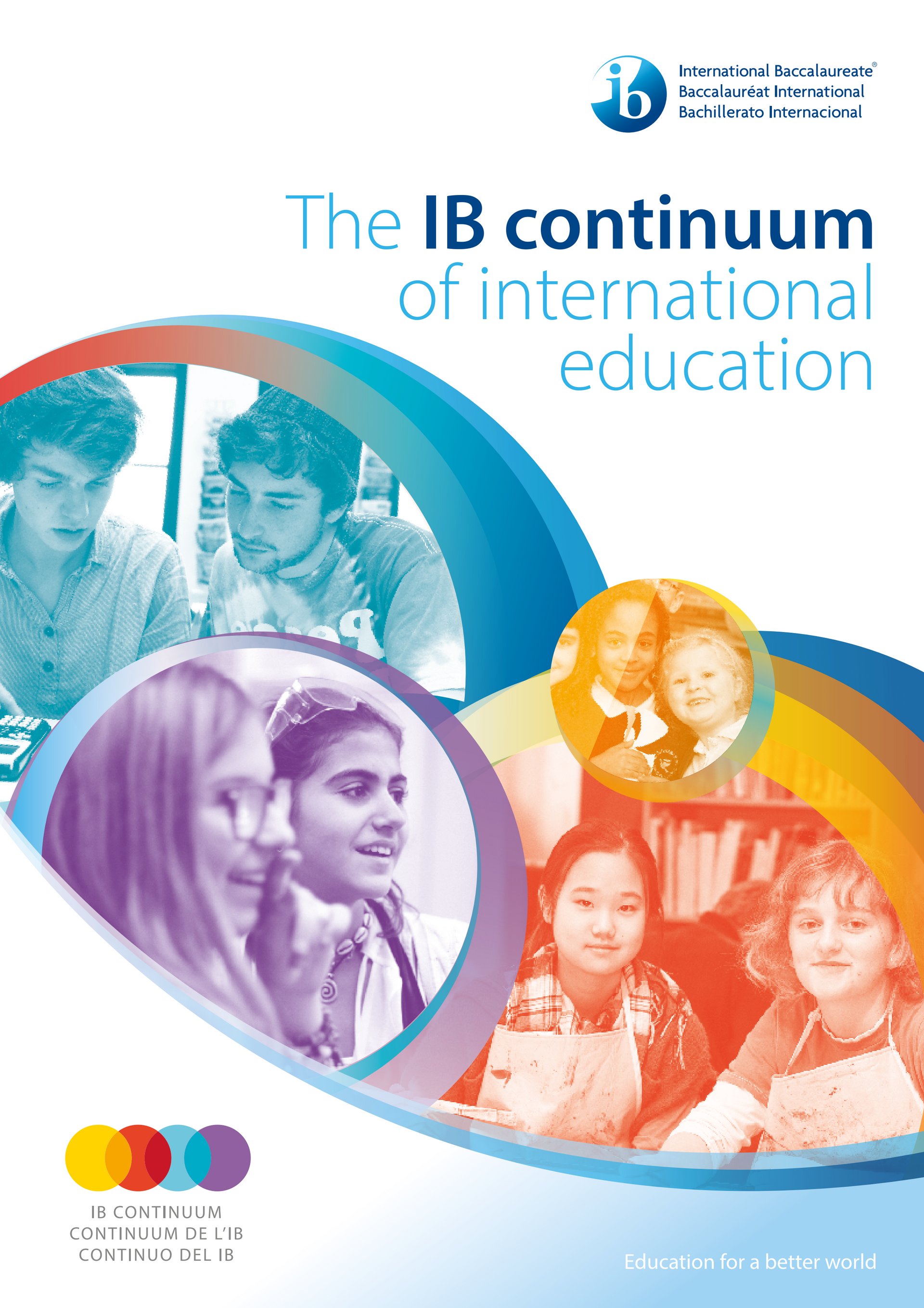
The IB continuum of international education for 3-19 year olds is unique because of its academic and personal rigour. We challenge students to excel in their studies and in their personal growth. We aim to inspire a quest for learning throughout life that is marked by enthusiasm and empathy.
The IB Continuum of international education (PDF, 1.8 MB)
The PYP curriculum is a student-centered approach to education for children aged 3-12. The framework begins with the premise that students are agents of their own learning and partners in the learning process. It prioritizes people and their relationships to build a strong learning community. PYP students use their initiative to take responsibility and ownership of their learning. By learning through inquiry and reflecting on their own learning, PYP students develop knowledge, conceptual understandings, skills and the attributes of the IB learner profile to make a difference in their own lives, their communities and beyond.
IB Primary Years Programme brochure (PDF, 2.5 MB)
The MYP is designed for students aged 11 to 16. It provides a framework of learning that encourages students to become creative, critical and reflective thinkers. The MYP emphasizes intellectual challenge, encouraging students to make connections between their studies in traditional subjects and the real world. It fosters the development of skills for communication, intercultural understanding and global engagement—essential qualities for young people who are becoming global leaders.
IB Middle Years Programme brochure (PDF, 395 KB)
The IB Diploma Programme is an academically challenging and balanced programme of education, with final examinations, that prepares students aged 16 to 19 for success at university and in life beyond. It has been designed to address the intellectual, social, emotional and physical well-being of students. The programme has gained recognition and respect from the world’s leading universities.
IB Diploma Programme brochure(PDF, 1.1 MB)
The IB Career-related Programme (CP) is designed for students interested in pursuing a career-related education in the final two years of secondary school. It provides them with an excellent foundation to support their further studies, as well as ensure their preparedness for success in the workforce.
IB Career-related Programme brochure (PDF, 584 KB)
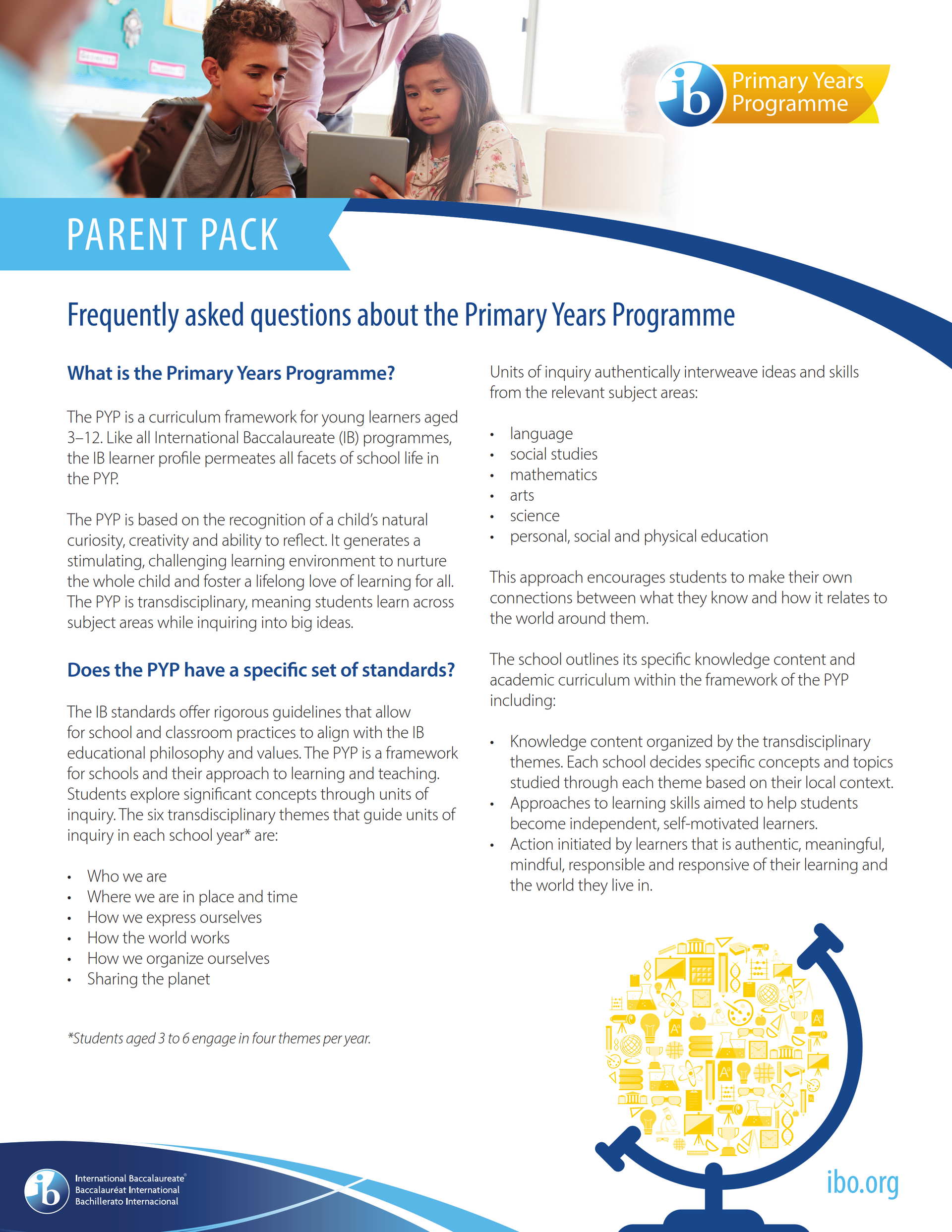
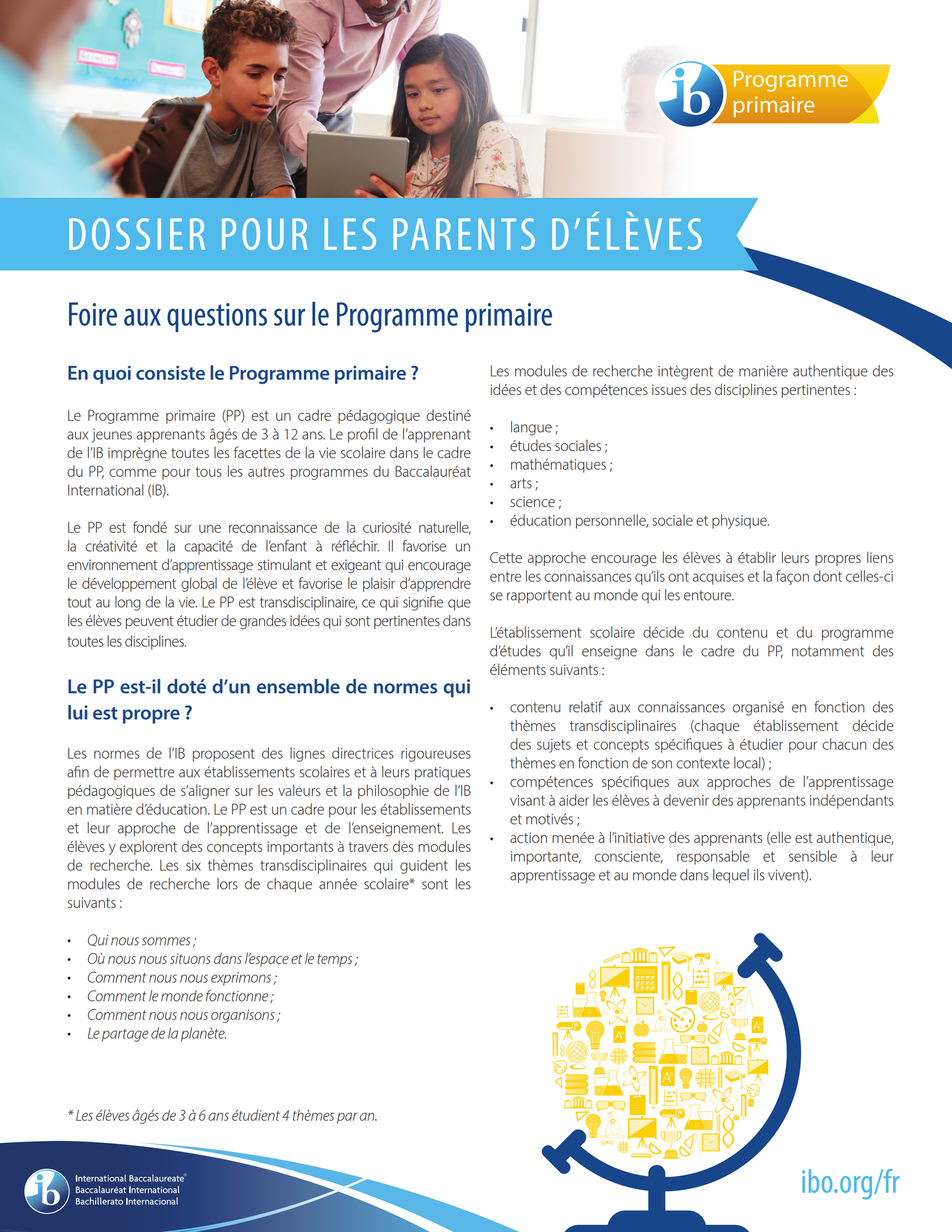
PARENT PACK
Frequently asked questions about the Primary Years Programme
What is the Primary Years Programme?
Does the PYP have a specific set of standards?
What are the advantages of an IB education?
Have studies been done on the impact of the PYP?
When do students start and finish the PYP?
When do they transition to the MYP?
Are IB programmes considered, “gifted”, programmes?
Frequently asked questions about the PYP (PDF, 583 KB)
Teachers' training agreement with Clermont Auvergne University
EIFJ Tokyo has signed a framework agreement with the Higher National Institute for Teaching and Education (INSPE) of the University of Clermont Auvergne, well known in the French education network to train future teachers in French schools around the world. EIFJ Tokyo will therefore have the honor of welcoming, from September 2021 (then throughout the school year) a first student-teacher in training within EIFJ team. This training, lasting three months or more, allows EIFJ not only to benefit from the qualities of future teachers who fully understand the challenge of teaching in French to non French speakers, but also students to learn about the educational measures implemented for their future missions.
By merging our energies and combining our educational strategies, we manage to become an example for French education abroad, an example of academic success and students’ well-being.
Other accreditations & affiliations' goals
- Western Association of Schools and Colleges (WASC)
- Council of International Schools (CIS)
- East Asia Regional Council of Overseas Schools (EARCOS)
- Japan Council of International Schools
- Tokyo Association of International Preschools
*Ecole Internationale Franco-Japonaise is a candidate school* for the International Baccalaureate (IB) Middle Years Programme. This school is pursuing authorization as an IB World School. IB World Schools share a common philosophy- a commitment to high-quality, challenging, international education- that EIFJ believes is important for our students.
**Only schools authorized by the IB Organization can offer any of its four academic programmes: the Primary Years Programme (PYP), the Middle Years Programme (MYP), the Diploma Programme (DP), or the Career-related Programme (CP). Candidate status gives no guarantee that authorization will be granted. For further information about the IB and its programmes visit http://www.ibo.org.